
Independent Marine HVAC Audit on Yachts: Why Do It Regularly
A HVAC system that “works” is not necessarily one that works well. On a yacht, degradation is gradual, symptoms are often masked by rough adjustments, and root causes are rarely visible without measurements. An independent audit — conducted by a neutral specialist — is the most effective way to establish an objective picture, prioritise actions and avoid reactive spending.

An independent marine HVAC audit is an objective assessment of the air conditioning, ventilation and heating systems on board a yacht. The word “independent” is essential: the auditor is neither the equipment manufacturer nor the regular maintenance provider. They have no commercial interest in recommending any particular product or solution.
The goal is to establish a factual, documented picture of the system as it actually performs under real operating conditions — not as it should perform according to the original drawings or the last technician’s report.
- Visual and documentary inspection of equipment (chiller, fan coil units, ductwork, ventilation).
- Field measurements: temperatures, pressures, flow rates, humidity, noise levels.
- Assessment of actual performance versus nameplate specifications.
- Review of controls, setpoints and control sequences.
- Check of refrigerant traceability records and maintenance logs.
- Identification of risk points, non-conformities and improvement opportunities.
- Structured report with prioritised recommendations and estimated impact.
An audit is not a maintenance visit. It is a structured external review that results in an action plan — not a parts invoice.
The question is fair. Why not simply ask the technician who handles maintenance to give their view on the system’s condition?
The answer is structural. A maintenance contractor is involved in the system’s history. They have made choices, carried out work and possibly raised quotes. Their assessment is sincere in most cases — but it is rarely neutral in the strict sense. An independent auditor arrives without bias, with no history to defend, and with a systematic measurement method that is not shaped by any commercial relationship.
What independence brings
- External perspective with no history to protect.
- Standardised, documented measurement methodology.
- Recommendations free from any interest in contractor selection.
- Objective reference to compare and challenge quotes.
- Report usable in the event of a dispute or transaction.
Limits of a contractor-led assessment
- Unconscious bias towards solutions they already know.
- Less incentive to flag issues with their own past work.
- Rarely formalised measurements or a structured report.
- Scope typically limited to their area of work.
- Recommendations are hard to challenge without a second opinion.
“An independent audit doesn’t challenge the contractor — it gives the owner an objective baseline to make decisions, set budgets and steer maintenance.”
There is no universal frequency. It depends on the vessel’s age, intensity of use, history of faults and the specific context — refit, purchase, change of management. A few practical reference points:
Before an intensive season
Mediterranean summer, Caribbean winter
- Verify the system can handle the thermal load ahead.
- Identify issues to address before operational pressure peaks.
- Avoid breakdowns mid-charter season or during a cruise.
Pre-purchase or due diligence
Acquisition, management takeover
- Understand the real condition of the system beyond paperwork.
- Quantify corrective work to factor into the negotiation.
- Avoid costly post-transaction surprises.
Before or after a refit
Project scoping or work acceptance
- Before: define the actual technical scope, avoid unnecessary work.
- After: confirm the work carried out meets its objectives.
- Documentation baseline for warranties and future management.
Recurring problems
Faults, discomfort, rising costs
- Repeated failures with no clearly identified root cause.
- Persistent comfort issues despite multiple interventions.
- Rising maintenance bills with no visible improvement.
Vessels over five years old
Periodic review recommended
- Silent degradation accumulates without triggering alarms.
- Original configurations no longer match actual usage patterns.
- An audit every 2–3 years keeps you ahead of failures.
Change of manager or crew
Handover of responsibility
- Establish an objective baseline at the point of handover.
- Document watchpoints for the incoming crew.
- Protect each party’s liability position.
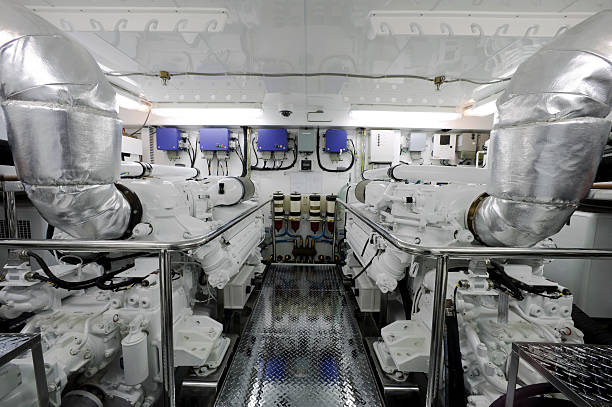
Field experience consistently shows that yacht HVAC systems have gaps between perceived performance and actual measured performance. These gaps don’t always trigger alarms — but they translate into costs, discomfort and latent risk.
- Heat exchanger fouling (condenser, evaporator, fan coil coils) reducing thermal transfer efficiency.
- Flow imbalances in chilled water or air distribution: some zones over-supplied, others starved.
- Untreated or unmonitored chilled water quality, causing internal corrosion and scale build-up.
- Inconsistent controls: drifting sensors, overly aggressive setpoints, poorly configured start-up sequences.
- Absent or incomplete refrigerant traceability, masking slow leaks over time.
- Insufficient technical ventilation in chiller and machinery spaces, degrading equipment reliability.
- Degraded ductwork and insulation, causing condensation, thermal losses and noise transmission.
- Missing or obsolete documentation: drawings, schematics and intervention history unavailable.
A serious audit is not a courtesy visit with a checklist. It follows a structured, repeatable method that allows performance to be compared across time and improvements to be measured.
- Phase 1 — Preparation: collection of drawings, schematics, maintenance records and refrigerant logs. Identification of the areas to be covered and the conditions available for the audit.
- Phase 2 — Documentary review: analysis of equipment data sheets, work orders, refrigerant traceability records and logged alarms.
- Phase 3 — Field measurements: systematic readings (air and water temperatures, pressures, flow rates, humidity, noise levels). Visual inspection of accessible equipment.
- Phase 4 — Analysis and synthesis: measured values compared against nominal specifications. Root causes identified, findings ranked by criticality and impact.
- Phase 5 — Report and recommendations: structured document with illustrated findings, identified causes, prioritised actions, effort estimates and suggested intervention windows.
The audit report is a decision-making tool, not a surveyor’s certificate. It must be usable by the owner, captain and manager — without deep technical expertise.
Lower maintenance costs
- Identify unnecessary or redundant interventions.
- Plan preventive actions before failures occur.
- Better control of annual maintenance budgets.
- Fewer costly emergency call-outs.
Improved on-board comfort
- Flow balancing for even distribution across all zones.
- Humidity control and air quality improvement.
- Reduction of HVAC-related noise on board.
- Greater reliability under intensive use.
Energy efficiency
- Detection of refrigerant leaks and thermal losses.
- Optimisation of setpoints and control sequences.
- Reduced electrical consumption from the HVAC system.
- Alignment with emissions reduction objectives.
Documentary value
- Up-to-date technical file, usable in pre-sale context.
- Reference baseline to challenge contractor quotes.
- Protection in the event of a dispute over system condition.
- Structured history transferable to a new crew.
“The cost of an audit is a fraction of the cost of a mid-season breakdown, a compressor replacement decided in haste, or a sale negotiation weakened by an incomplete technical file.”
How long does an on-board HVAC audit take?
For a yacht between 24 and 40 metres, half a day to a full day of field work is typically required. Preparation time (document collection) and analysis time (report writing) are additional and carried out off the vessel. The report is generally delivered within 5 to 10 working days.
Does the yacht need to be at berth and on shore power?
That is preferable, to access all equipment and run the system under stable conditions. Some measurements can be taken under way, but repeatability is better at berth with a controlled thermal load.
Does an audit replace the annual maintenance?
No. An audit and maintenance are complementary. The audit assesses, analyses and recommends. Maintenance executes the preventive and corrective actions. An audit can, however, redefine the maintenance scope and eliminate unnecessary work.
What happens if the audit uncovers serious problems?
The report identifies criticality levels: urgent, important, to be scheduled. For critical points (imminent failure risk, safety), immediate action recommendations are included. RivierX can support the implementation of corrective work or simply provide the technical specifications for your chosen contractor to carry out.
What is the difference between an audit and a pre-purchase survey?
A pre-purchase survey is an audit in a specific context: available time is often limited, and the goal is to quantify work required and identify hidden risks for the negotiation. The underlying method is the same, but the deliverable is tailored to the transactional context.
Tell us the port, vessel size and objective — RivierX will return a scope and quote within 24 hours.